

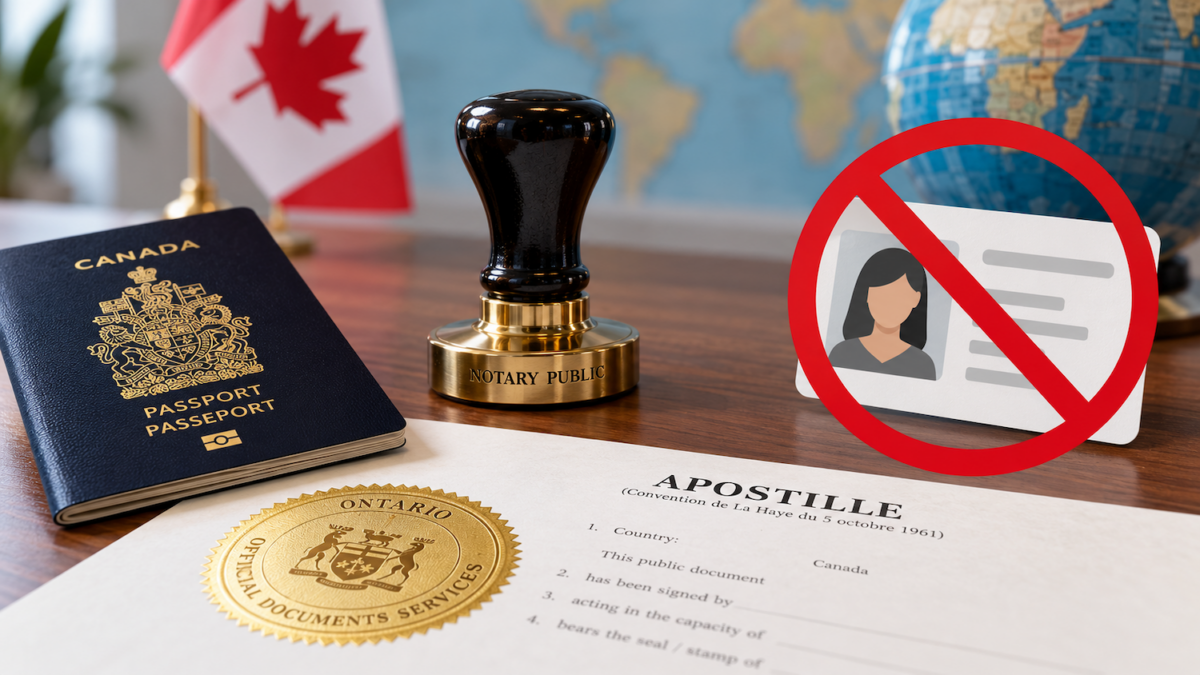
Does a Consulate Need a Copy of Your Notary’s ID? Understanding Notary Verification in Ontario
If you’ve had a document notarized in Ontario for use abroad, you may encounter an unexpected request from a foreign consulate, embassy, or other organization: they want a copy of your notary public’s personal identification.
This might include the notary’s driver’s licence, passport, or another form of government-issued photo ID.
While we understand that foreign authorities sometimes have additional verification requirements, requesting a notary’s personal identification is generally unnecessary and is not the appropriate method for verifying their professional credentials.
Fortunately, Ontario has an established process for verifying the authenticity of notarized documents, and it’s important for clients to understand how that process works.
How Are Notaries Public Verified in Ontario?
In Ontario, there are established ways to verify a notary’s professional credentials without requesting their personal identification.
1. The Law Society of Ontario
All notaries at Walk-In Notary are licensed lawyers registered with the Law Society of Ontario (LSO).
The Law Society maintains a publicly accessible directory that allows anyone, including foreign authorities, to verify a lawyer’s licensing status and other professional information.
You can access the directory here:
Law Society of Ontario Lawyer and Paralegal Directory
While this directory can verify a lawyer’s professional standing, it does not replace the formal process for authenticating a notary’s signature and seal.
2. Official Documents Services (ODS)
Official Documents Services (ODS), operated by the Ontario government, is responsible for authenticating eligible Ontario documents intended for use outside Canada.
ODS maintains records of notarial signatures and seals. When a notarized document is submitted for authentication, ODS checks whether the notary’s signature and seal match its records.
If the document meets the applicable requirements, ODS can issue an official certificate of authentication or an apostille.
This provides independent government verification of the notarial signature and seal, without requiring the disclosure of the notary’s personal identification.
You can learn more about this process directly from the Ontario government:
Authenticating a Document for Use Outside Canada
What Is an Apostille, and Why Is It Important?
An apostille is an official certificate used to authenticate public documents for use in countries that are members of the Hague Apostille Convention.
Canada joined the Convention on January 11, 2024, making the process of authenticating Canadian documents for international use considerably simpler.
For eligible notarized documents originating in Ontario, ODS can issue an apostille confirming the authenticity of the notary’s signature and seal, as well as the capacity in which the notary acted.
An apostille does not certify that everything written in the document is true. Rather, it provides official confirmation of the relevant signature, seal, and authority.
For countries that participate in the Convention, an apostille generally replaces the need for additional consular legalization.
For more information, see our article on the new Canadian apostille rules.
What If the Indian Consulate Requests My Notary’s ID?
We occasionally receive questions about documents intended for use in India, including situations where clients have been asked to provide additional information about the notary who notarized their documents.
Both Canada and India are members of the Hague Apostille Convention.
In fact, the Consulate General of India in Toronto has expressly confirmed that Canadian documents apostilled by a recognized Canadian authority do not require further attestation or legalization by the Indian Consulate.
This clarification was published on September 5, 2024.
You can read the Indian Consulate’s official announcement here.
If an Indian authority requests additional verification of an Ontario notary’s credentials, the appropriate solution will generally be to use the established apostille process, rather than requesting copies of the notary’s personal identification.
Of course, you should still confirm the specific document requirements with the intended recipient in India. Different types of documents may have different requirements.
Will Walk-In Notary Provide Copies of Its Notaries’ Personal Identification?
No. Walk-In Notary does not provide clients, foreign consulates, or other third parties with copies of its notaries’ personal identification for routine verification purposes.
Our notaries’ professional credentials can be verified through established channels, and their personal identification is neither necessary nor appropriate for that purpose.
We take the privacy and security of our notaries seriously, just as we take the privacy and security of our clients seriously.
All of our notaries are licensed Ontario lawyers, and their signatures and seals are registered with ODS for authentication purposes.
What Should I Do If a Consulate or Foreign Authority Asks for My Notary’s ID?
If you’ve been asked to obtain a copy of your notary’s personal identification, we recommend the following:
- Confirm the request. Make sure the receiving authority is actually asking for the notary’s identification, rather than your own identification or an official certificate authenticating the notarized document.
- Ask whether an apostille is required. In many cases, an apostille is the appropriate way to verify the authenticity of a notarized document intended for use abroad.
- Consult Official Documents Services. If your document requires authentication, review the Ontario government’s procedures to determine whether it is eligible for an apostille or certificate of authentication.
- Contact our management team if you require clarification. If the receiving authority insists on obtaining personal information about one of our notaries, please send us the request in writing so that we can review it.
Please understand that while we can provide clarification about our notarization services, Walk-In Notary does not issue apostilles. Those certificates are issued by the appropriate government authority.
Can a Foreign Authority Refuse to Accept My Notarized Document?
Foreign authorities and other document recipients may have their own requirements concerning document format, content, authentication, and submission procedures.
Although an apostille is intended to eliminate additional legalization requirements between participating countries, it does not guarantee that every document will be accepted for every purpose.
For this reason, we always recommend confirming the recipient’s requirements before having your documents notarized.
However, if the issue is simply verifying that an Ontario notary is properly authorized and that their signature and seal are authentic, established verification procedures are available without requiring copies of personal identification.
Questions About Your Notarized Documents? Contact Walk-In Notary
At Walk-In Notary, we understand that dealing with foreign consulates, embassies, and international document requirements can sometimes be confusing.
We are committed to performing notarizations accurately and helping our clients understand the procedures involved.
If a consulate or other organization is requesting additional information about one of our notaries, please email our management team at info@walkinnotary.com.
We would be happy to review the request and provide appropriate clarification.
For general information about notarization services, visit Walk-In Notary.
Recent Post
If you’ve had a document notarized in Ontario for use abroad, yo...

At Walk-In Notary, we take responsibility for the work we do. If we ma...
There seems to be a lot of confusion surrounding “online notariz...

One of the most common questions we get is simple: “How long will I ...